
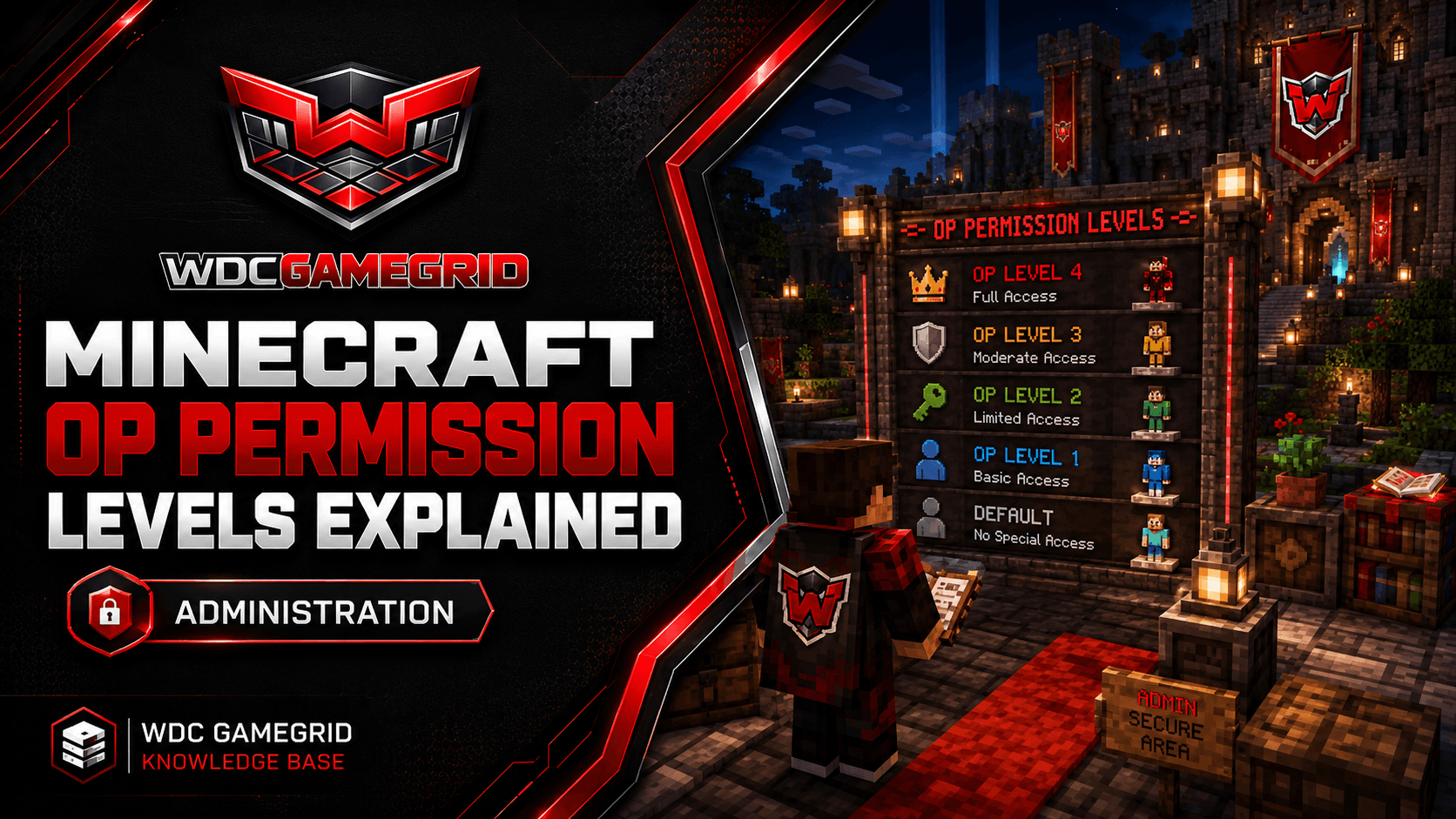
Minecraft OP Permission Levels Explained
What each OP level (1-4) can do, how to assign them, and security best practices.
How to OP a Player
There are three ways to give a player operator status:
Via the Settings tab: Settings > Player Management > "Admins / Operators" > Add Admin. Enter the player's name or UUID and pick a level from the dropdown. This is the easiest method on GameGrid and it writes ops.json for you.
Via console: type op PlayerName in the Console tab. The player gets the level from op-permission-level in Settings (default 4).
Via ops.json: edit ops.json in the server root from the Files tab, with the server stopped. Restart afterwards.
The panel's level dropdown is labelled Level 1 (Basic), Level 2 (Commands), Level 3 (Multiplayer) and Level 4 (Full Admin) - the same four levels described below.
The Four Permission Levels
Level 1 (Basic): bypass spawn protection. Good for trusted builders who only need to work near spawn.
Level 2 (Commands): Level 1 plus the single-player cheat commands - /clear, /difficulty, /effect, /gamemode, /gamerule, /give, /summon, /setblock, /fill, /clone, /tp, /time, /weather - and command blocks. Good for event coordinators.
Level 3 (Multiplayer): Level 2 plus the player-management commands - /ban, /ban-ip, /pardon, /kick, /op, /deop, /whitelist. Good for administrators who moderate people.
Level 4 (Full Admin): Level 3 plus /stop, /save-all, /save-on and /save-off. Full control. This is what op-permission-level defaults to, so a plain "op PlayerName" grants it. Give it only to people you fully trust.
Setting Specific Levels
op-permission-level in Settings (default 4, range 1-4) controls what level a new op gets. Lower it if you do not want every op to have full control.
To assign different levels to different players, edit ops.json directly. Each entry has a "level" field:
{"uuid": "player-uuid", "name": "PlayerName", "level": 2}
You can also use the console: op PlayerName gives the default level. To change a specific player's level, deop them first (/deop PlayerName), then edit ops.json and restart.
Security Best Practices
Don't OP people you don't trust. Level 4 ops can stop the server, delete worlds, and ban everyone.
Use lower levels for moderators. Level 1 or 2 is enough for most community helpers.
Only give Level 4 to one or two people you trust completely - ideally just yourself.
If an op goes rogue, deop them immediately from the Console tab: deop PlayerName. Then check what they did - ops can't be undone automatically.
Keep the number of ops small. More ops means more people who can accidentally (or intentionally) break things.