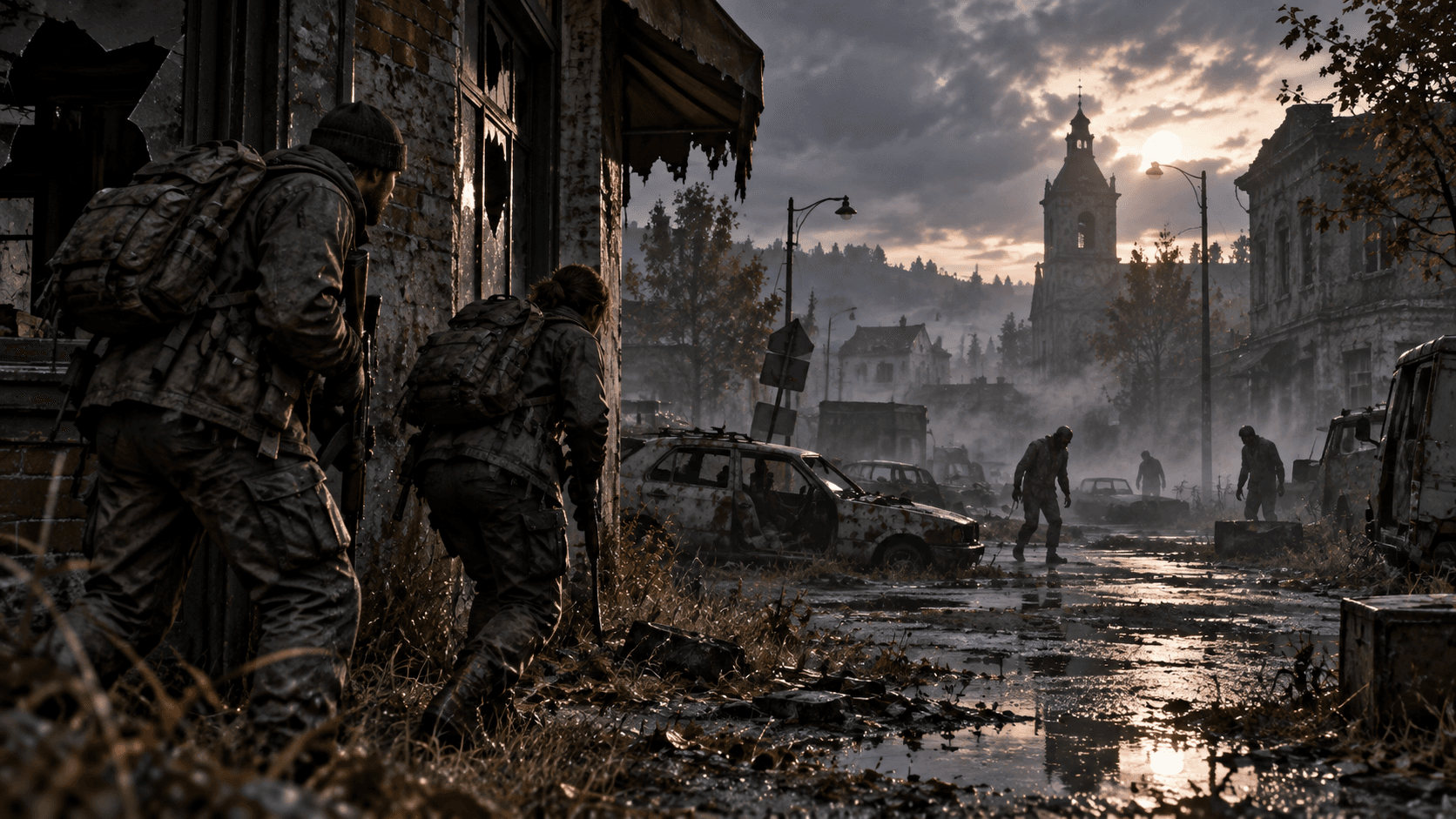
Battle Royale Rounds on Your DayZ Server
A last-one-standing round on a temporary server built beside your own, with a closing ring and a scoreboard. How a round is set up, what it costs you, how it is scored, and why your survival world is never touched.
What a Round Is
A Battle Royale round is a last-one-standing match with a ring that closes over two hours.
It runs on a temporary server we build beside yours and delete afterwards. Your own server keeps running the whole time, on the same address, and nothing on it is touched. Your players' survival characters, their bases and their stashes are on the other server, and the round never reaches them.
You set one up on your server's DayZ Tools page, under Battle Royale.
What a round needs, and where that stands today. The closing ring is part of the GameGrid DayZ server mod, and it arrived in mod 1.5.0; a circle that moves between phases needs 1.6.0. When your server's host runs an older build, pressing Start is refused with the reason (the build it found and the one it needs), and your day is not used up. As of this article's date, mod 1.5.0 has been built but has not yet been released to game hosts, so today a round cannot be started. Everything below describes how a round works on a host that has it.
Before anything else on this page: asking for a round and starting it are two separate presses. Requesting one draws the schedule and spends nothing, but it does take your account's one in-flight round slot until you start it or cancel it. Start is the press that spends your day and builds the round server. Give the round a start time when you ask for it and GameGrid makes that second press for you, at that time.
The ring map anybody can open
Asking for a round also makes that round its own ring map link: a web page showing the circle where it stands, which anyone can open without a GameGrid account. It is on the round's own page, and the /dayz ring-map command posts it into a Discord channel for you.
It never shows where anybody is. A ring link carries the map and the circle and no player feed at all. That is decided when the link is made rather than when it is opened, so a link cannot be talked into listing your players later.
The link lasts 24 hours. A round with a start time gets a link that lasts past the end of the round instead: 7 days, or 30 when the round is more than about a week away. It counts against the five live share links a server may hold at once. At the cap no link is made for that round — the round itself is unaffected and runs exactly as it would have, and the page says so rather than showing an empty box. Revoke a link on the Economy page and the next round gets one. Revoking a link, or letting it expire, closes it immediately for everybody who had it, and the page says which of the two happened.
Setting One Up
Five settings, and the schedule redraws as you change them.
| Setting | Range | What it decides |
|---|---|---|
| Map | The maps your server offers | Where the round is played |
| Players | 2 to 60 | The size of the round |
| Join window | 2 to 14 minutes | How long people have to get in |
| Shrink length | 20 to 110 minutes | How long the ring takes to close |
| Final radius | 25 to 160 metres | How small it ends. The in-game ring is never smaller than 25 metres, and the shrink ends at 160 metres |
Saving these applies them and redraws the schedule. Nothing is written to your own server, and no round is requested until you press Request a round.
Choosing when it starts
Beside Request a round, Starts offers two choices:
- When I press Start, the default. The round waits until you press Start on it.
- At a time I choose. Pick a date and a time. They are read in your timezone (the one saved on your profile, or your browser's until one is saved), and the page shows the same moment in UTC beside it, the way the Event Manager does.
At that time GameGrid starts the round exactly as pressing Start would: the checks run first, then your day is spent, then the round server is built. It usually accepts players two to five minutes later, and the join window opens then. So if you want people playing at 8:00 PM, set the round for a few minutes before.
A time that has already passed is refused, and so is one more than 14 days ahead. While it waits, the round shows its start time in your timezone and in UTC, and you can still press Start early or Cancel it.
If the host is busy, or does not answer, at that time, GameGrid keeps trying for 30 minutes and the page shows why it is waiting. If the round still cannot start, or cannot start for a reason that will not clear by itself, it is called off with the reason and nothing is charged against your day.
A round with a start time is charged to the day it starts, in your timezone.
A round has thirteen phases: a deployment phase, nine shrinks and a three-step endgame, ending inside two hours including setup. At the cap the round is scored where it stands.
The ring steps; it does not glide
DayZ cannot resize a contaminated zone, so each phase is a whole new set of areas. The boundary holds still and then jumps. That is why the settings ask for a phase length and not a shrink speed.
What the ring does to a player outside it
The ring hurts. Stepping over the edge and turning straight round costs very little: there is a short grace period, and nothing at all happens inside it.
After the grace the player coughs, and the ring puts them back inside — up to three times in a round. Each one starts the grace again, and one is not used up when there is nowhere safe on the ground to put them.
Once those three are used up, a player outside the circle loses health every second they stay out, on the game server's own clock, at the rate the schedule shows for that phase. The rate rises with each phase, so a late circle is far less forgiving than an early one.
A player the ring would take to zero health is out of the round at that moment. The placement is written down first and the player is removed from the server second, so a kick that fails cannot put somebody back into a round they have already lost.
A schedule you could not walk is refused before you start
The schedule is arithmetic, not a rehearsal. It is worked out from the map size and a walking speed. The plan assumes a player walks 180 metres a minute across real terrain, and no phase may ask for more than about 60% of a phase's walking budget to reposition. A combination that fails that is refused when you configure it, with the arithmetic shown, rather than discovered by somebody at minute 27. The fix is a longer shrink or a larger final radius, and the page says which.
How Your Players Get In, and Back Home
While the join window is open, the round's page shows a How players join card: the round server's address with a Copy address button, and an Open in DZSA Launcher link. In DayZ, players log out of your server and use Direct Connect with that address, or add it to their favourites before the round starts. Their character on your server stays where they left it. The DZSA Launcher link works only while DayZ is closed.
GameGrid also sends the address to everybody playing on your server, as a notification and a line in chat: once when the round opens, and again 5 minutes and 1 minute before entry closes. Each message gives the round server's address for Direct Connect and how long entry stays open, and the first one tells players to log out of your server first because their character stays where they leave it. Your server keeps running and nothing on it changes. Nothing is sent for a round that has no public address.
Two Advanced settings on the round control this. Tell players on your server switches the messages off. Remind them before entry closes takes the minutes, written like 5, 1: whole minutes from 1 to 13, up to four of them, and an empty box means the opening message only. A reminder as long as the join window or longer is skipped.
In Discord, the round's post in your alert channel carries a Join with DZSA Launcher button next to the address. When entry closes, that post is edited to say entry has closed and the round is under way, with no address and no button.
When the round ends, GameGrid sends a message on the round server saying it is closing and giving your server's address, then removes each player still on it with the reason "Round over. Rejoin your server:" followed by that address. A player who has already left is skipped. The removals during the round (a player who joined late, one who is out of the round) carry your server's address in their message too when it fits.
One Round at a Time, and What That Costs You
One round a day, in your own timezone. The day is spent when you press Start, or at the start time you gave the round, never when you ask for a round. A round you have asked for and not started has not spent it; a round you have started has. The checklist runs before the spend, so a host that is full or a mod that is quiet costs you nothing.
What is enforced today, and will surprise you if we do not say it:
One round can be waiting or running at a time, across your whole account — not per server. A round waiting on one of your servers refuses a round on every other server you own, and the refusal says so when it happens.
A round you have not started, and gave no start time, does not time out. Nothing advances or expires it, so it holds that slot until you clear it. Use Cancel on it, which the panel offers next to it; that is the only thing that clears it. A round with a start time clears the slot by itself: it starts at that time, or it is called off with the reason.
One round per host at a time. A busy host holds your round rather than failing it straight away, and the panel says which of the two it is doing. If the host keeps turning the round away, GameGrid stops after 30 minutes: the round is called off with the reason and your day is given back. Cancel it sooner if you would rather have the slot back.
Four things give the day back: a round that fails to build or to start (this includes a round whose own settings the platform refuses when it starts, such as a saved final radius under 25 metres, a check that runs before anyone is moved; a started round the host kept turning away for 30 minutes; and a round whose ring your server could not set up while the players were being placed), an arena nobody joins, a round abandoned at the close of the join window for being too thin, and a round the platform ends because its host stopped answering before the round was under way. Once the players are placed and the ring is closing, the round has been played: if it fails after that, the day stays used. Cancel gives it back too, but only while the arena has not been built yet (the round is still requested or queued). Cancelled after the platform has started building the arena, and before the players are placed, the round ends and the day stays used. A walkover is not one of those — a round with one real player who wins is a real round, it uses the day, and it pays no prize.
How a Round Is Scored
The order is simple and it is not negotiable: anyone still alive places above everyone who was eliminated. Among survivors, in order:
1. most kills in the round
2. best condition — health and blood together
3. least damage taken from the ring
4. earliest to join
Still level on all four, it is a draw: those players share first place and no winner is recorded. Among the eliminated, surviving longer is the better placement, and two people eliminated in the same moment with the same kills share the place.
When the ring finishes with more than one player alive, the round still has a winner. The order above decides it, and the player it puts alone in first place is recorded as the winner, just as a last player standing is. A round that reaches its time cap is decided the same way. When the round ends, the round server tells everyone in it what the result says: that there is a winner, with which of the four decided it when more than one player was still standing, or that it is a draw.
Kills are counted. The round reads the GameGrid mod's death feed on the round server, which names the killer, and credits a participant with one kill for each other participant they put out during the round. A kill counts once: a replayed read or a player dying again after they are out adds nothing. A death in the gas, to the infected, an animal or a fall, and a player killing themselves, credits nobody, and so does a kill by somebody who is not in the round. Kills stop counting the moment the round is scored, so the places recorded and the kills recorded with them always agree. While a round is on, the This round panel on the Battle Royale page shows each participant's kills.
Round deaths are on your killfeed, marked Battle Royale. Every death in a round appears on your server's killfeed with a Battle Royale badge, and on a public map link and the Discord /dayz killfeed command marked the same way. They are not counted on your server's leaderboard, in survivor profiles or by your in-game events: a round is a different mode with its own scoreboard, so a round kill never pays an event's per-kill bonus and never moves anybody up the survival board.
A round where nobody is left standing is a draw, not a win, even when one player went out a moment after the rest. Calling it a win would print the same word for "somebody survived" and "the ring killed everybody". So a round is a draw in two cases only: nobody is left standing, or the players still standing are level on all four.
Who counts as a participant
Everyone who joins during the join window is a participant, including a player who leaves again before it closes. The list freezes when the window closes, and nobody who connects after that can join the round.
A participant who is not in the round once it starts, whether they left during the window or disconnect later, is out of the round as having left if they are not back within two minutes of leaving. They are placed below everyone still standing, and they count towards the number of players the round had.
If fewer players than the round's minimum joined during the window, the round is abandoned, your day is refunded, and the panel says why rather than leaving an unexplained "abandoned".
The day is still given back every time, but a server cannot do this over and over: when three rounds on it have ended this way within 24 hours, a new round request is refused until an hour after the last of them ended. The refusal says how many minutes are left ("You can ask for a new round again in N minutes"), and the same refusal stops an event that would start a round.
Why Your Survival World Is Safe
This is the part that got the most care, because the failure it prevents is the worst one available in a survival game.
If the round's server ever shared player storage with your own, every death in the round would write onto a real survival character, the round's starting kit would overwrite somebody's real gear, and cleaning up the round would delete your whole player population.
So the two are kept apart by where they live and by who is allowed to name them, rather than by a check somebody has to remember to run:
- the round's server is its own folder beside yours and never inside it, with its own ports, its own world and its own storage
- your server is never named in the clean-up. We send the host your server's id, the host works out the round server's name itself, and it refuses an id that is already a round server
- the clean-up empties storage inside the round server's own folder only, and refuses to delete through a junction or a shortcut
- the round's server is never registered as one of your servers, so nothing that sweeps, restarts or backs up your servers can see it
- a round refuses to start on a host still holding the last round's world, and says what it found
Nineteen checks run before a round starts, including whether your host's mod has the ring at all, and they stop at the first failure — with the reason, and with the thing that would clear it. A check the host will not answer is named rather than counted as a pass. You can run the same list as a preview without spending your day, but a preview is never a clearance: the list runs again at the press, and again when the round server is built, because a host can fill up in between.
What to Know Before You Run One
Four things about the shape of a round, so nothing about it is a surprise on the night.
- No gas wall is drawn. The ring is real and it hurts, but there is nothing at the edge to look at. The boundary is still enforced, on the clock, and players are told where it is by a grid reference.
- The circle moves as well as shrinks — when your server has mapped the ground and its host runs mod 1.6.0 or later. The GameGrid mod builds a height and water map of your world while your server runs. With one for the map your round is on, each phase is drawn a little off the one before it, never further than 60% of that phase's radius step, and a centre that would land in the sea is redrawn. Without one, every phase shares the centre you picked, and so does a round on mod 1.5.0: a circle in the sea is worse than a circle that does not move. The schedule page says which of the two your round is, and the round's own page says it again once it exists.
- There is no scoreboard, ring timer or map circle inside the game. DayZ's own map has no circle to draw and its interface is not ours to add to, and your players install nothing for GameGrid's rounds. So the round's scoreboard is a web page, and what reaches a player in game is words: the warnings, the countdown, and the grid square the next circle is in.
- A round cannot be cancelled once the players are placed. Before that, Cancel ends it, and gives the day back only if its arena was not built yet. After it, the round ends when somebody wins or at its own two-hour cap.
Who Can Do What
Previewing a round — the schedule, the phases, the refusals — needs only view access and changes nothing.
Requesting, scheduling, starting or cancelling a round needs the manage permission on your server. Both are recorded in your audit log either way.