
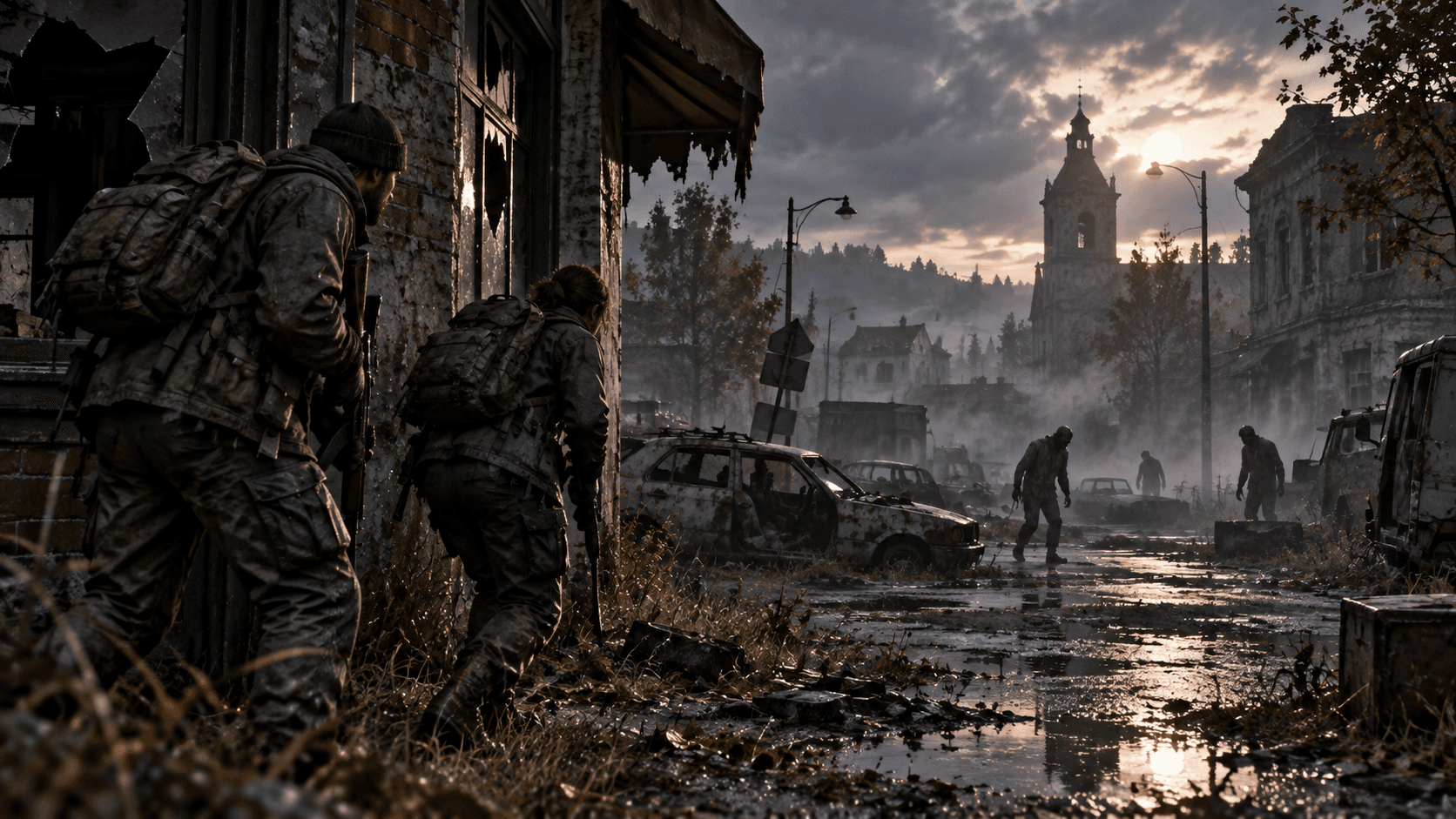
Zone Loot: Putting Chosen Loot Inside an Area on DayZ
Scatter containers full of loot you chose across a circle or a rectangle on your map. How the points are picked. Which three files it writes. Why a new layout needs a restart. And how a cadence keeps placing bursts on its own.
What Zone Loot Is
Zone loot puts real containers of loot you chose inside a shape you drew. You give it a circle or a rectangle, a container, and a list of items. You say how many points you want. GameGrid works out where each container goes.
It exists because DayZ has no setting for "more loot inside this circle". The game spreads its loot by building type and map tier, not by coordinate. There is no dial to turn. What the game does support is placing objects at set positions. Each one can carry its own loot table. That is the mechanism this uses.
You will find it on your server's DayZ Tools page, under Zone Loot.
A zone loot area and a zone are different things. A zone is a named area you draw on the live map. A zone loot table has its own shape, and it exists only to hold containers. Changing one never changes the other.
Building a Table
Press New loot table and work down the form.
| Setting | What it is |
|---|---|
| Name | Up to 45 characters. It becomes the name of the event in your files, prefixed GameGrid_ZL_. Keep it short. |
| Map | Chernarus, Livonia or Sakhal. A table belongs to one map. |
| Container | The object that holds the loot — a supply box, a barrel, a sea chest. One container class per map, per table. |
| Where this loot goes | A circle or a rectangle. Pick an area you already drew on the Zones page. Or put the shape on the map itself. |
| Points | How many containers, up to 128. |
| Minimum spacing | How far apart they have to be. |
| Seed | A word or number you keep. The same seed and the same shape always give the same points. |
Under the shape you get a line of arithmetic. It shows the area in square metres, and the most points that fit at your spacing. The panel works this out the same way the server does. A number it refuses here is a number the server would refuse too.
Spacing is never quietly relaxed. If the points will not all fit, we place what fits and tell you how many. We never move points closer together to reach a count.
Choosing where it goes
There are three ways, and typing a coordinate is the last of them. One of your saved areas is offered first — the circles and rectangles you drew on the Zones page. Each is listed with its size and its grid reference. On the map puts the shape straight onto your own map. Click or tap to put it down, then drag to size it. Arrow keys move it ten metres at a time. Typing the position in world metres is still there. Use it when you already have the numbers from somewhere else.
Whichever you use, the readout shows two things. The metres that go into the files, and the grid reference your players are told in an announcement. The two can never disagree.
Circles and rectangles only. A free-form outline is refused rather than approximated.
Choosing the Loot
Each line is an item class, a category, a maximum per container, and a weight. Add lines by hand with the item picker. It only offers classes your own server actually has. A class your server does not have is refused, not written. Names the game has never heard of produce empty containers.
Faster is to start from a grouping. Eleven ready-made sets are offered: top tier, high tier, military weapons, military ammunition and weapons. The rest are medical, explosives, food, tools and building, cold weather, and one item in quantity. A grouping fills the lines in; you then change whatever you like.
Groupings are built from your own files
Most groupings are read from your own mission's `db/types.xml`. That file says what your server spawns and how much of it. So "high tier" means the classes *your* server marks that way, not a list we decided. An item whose types.xml nominal is zero never spawns anywhere. Those classes are left out.
Your types.xml is read off the server while it is running. Until it has been read, those groupings are shown disabled, with the reason on screen. They are never hidden, so you can see what you are waiting for.
Weight is a share of the slots, not a chance
Weight is the share of a container's slots this line gets. It is not a spawn chance. mapgroupproto.xml is the file this writes into, and it has no per-item chance of its own. Which item of a category arrives comes down to the nominal values in your own types.xml. The share percentage on each line is what the panel is telling you.
When the Points Are Chosen
This is the part worth getting right before you build anything.
The points are chosen when you press Generate. They are then written into your mission files. DayZ reads those files once, when the server starts. The same crate stays in the same place until you generate again.
So:
- Preview runs the identical scatter Generate runs, from the seed already saved, and stores nothing. It is not an approximation of the result — it *is* the result.
- Re-roll picks a new set of points from the same seed. It is a regenerate and a restart, not an instant change. Your players see the new layout the next time the server starts.
- The mission-file layout has no clock of its own. Want the file-written layout to change over time? That is the Rotator. It hands a different table to a schedule you set up. Each change still lands at a restart. The live path is the other answer. A cadence places a fresh burst on your timetable. It can pick new points each time.
Change the shape, the point count, the spacing or the seed, and the saved points are cleared. The panel says so when it happens. That is deliberate: points that belong to a shape you no longer have are worse than none.
Getting It Onto Your Server
There are two ways, and you choose one per table.
Nothing reaches your server until you ask for it. Saving a table keeps it in the panel. Writing it, or placing it, is a second and separate press. A cadence places bursts only because you turned one on.
Written into your mission files
This is the normal one, and it needs no mod and no running server. Press Show me what would be written first — it changes nothing — then Write it into my files.
It writes three files:
| File | What goes in it |
|---|---|
db/events.xml | The rates — how many of your containers exist at once |
cfgeventspawns.xml | The points |
mapgroupproto.xml | The loot table itself |
The third one is easy to miss when you do this by hand. Miss it and your crates spawn empty.
Your own edits are kept. We back the file up outside your mission folder first. Then we write our own block between two markers, and check the bytes afterwards. If anything looks wrong we put the backup back. Everything outside our markers comes back exactly as it was. An event or a group that already exists outside our markers is refused rather than overwritten.
The change lands at the next restart, because that is when DayZ reads these files. Nothing appears while the server is running.
Placed live by the mod
The other way asks the GameGrid server mod to put the containers out now, on a running server. They go out a few at a time, not all at once. A whole zone takes a few seconds rather than arriving in one lump.
Live placement needs your server running and the mod reporting. Writing the mission files does not. You can set a table up on a stopped server, and it lands at the next start.
One burst is placed once. It is not topped up. Whoever gets there first empties a busy area, and it stays empty until the next burst. Each container clears itself away after the lifetime you set, up to an hour. That limit is the game mod's, not ours. Anything a player has already picked up is theirs to keep.
On a cadence, without you pressing anything
A live table can be put on a cadence: we place a fresh burst on a timetable you pick. It can pick new points before each burst. The layout then moves around your shape instead of settling in the same spots. Your seed stays yours and the roll moves on. If you move or resize the area the table follows, the next burst uses the new shape.
A cadence is a schedule in your Command Manager. We create the entry and you can see it there, edit it there, and delete it there. This page still runs no clock of its own.
One piece of arithmetic before you arm one. A container clears itself away after its lifetime, an hour at most. A gap longer than that lifetime leaves your area empty in between. We refuse that unless you ask for it, and we tell you how long the gap is. A cadence also needs the server up. Nothing is placed while it is down. The schedule tries again at the next run.
Turning the zone off stops us placing any more. It does not take back what is already out there. There is no request that removes a container early, on purpose. One that deleted objects by class name is how somebody loses their base storage. Each container still clears itself away when its lifetime ends. Whatever is inside it drops on the ground rather than being destroyed.
Sometimes the mod cannot say whether a container was placed. We leave it alone and tell you. We never send it again on your behalf. That is how one spot ends up with two crates of military loot.
What to Know Before You Build One
Two facts about DayZ decide more about a loot table than any setting on the page. Neither of them is going to change.
- No height is written. A position with no height is snapped to the ground by DayZ itself, exactly. Our own height would come from terrain samples 32 m apart. On a slope that would bury a crate or leave it floating. Where we have not measured the terrain yet we will not guess. So we cannot always say in advance whether a point is on a beach or in the water.
- This does not raise a loot tier. DayZ's tiers decide where on the map an item may appear. They are not a quality dial, and nothing here changes them.
And one habit worth having: write it, restart, and go and look at a point or two. Do that before you build a night around it. Two points on the ground tell you more than sixty coordinates.
Who Can Do What
Anyone who can view the server can read the tables and run either preview. A preview changes nothing at all.
Saving, generating, writing the files and deleting a table need the settings permission on that server. Placing loot live needs manage. A control you cannot use is shown disabled, with the reason beside it. The page never simply refuses without explaining.