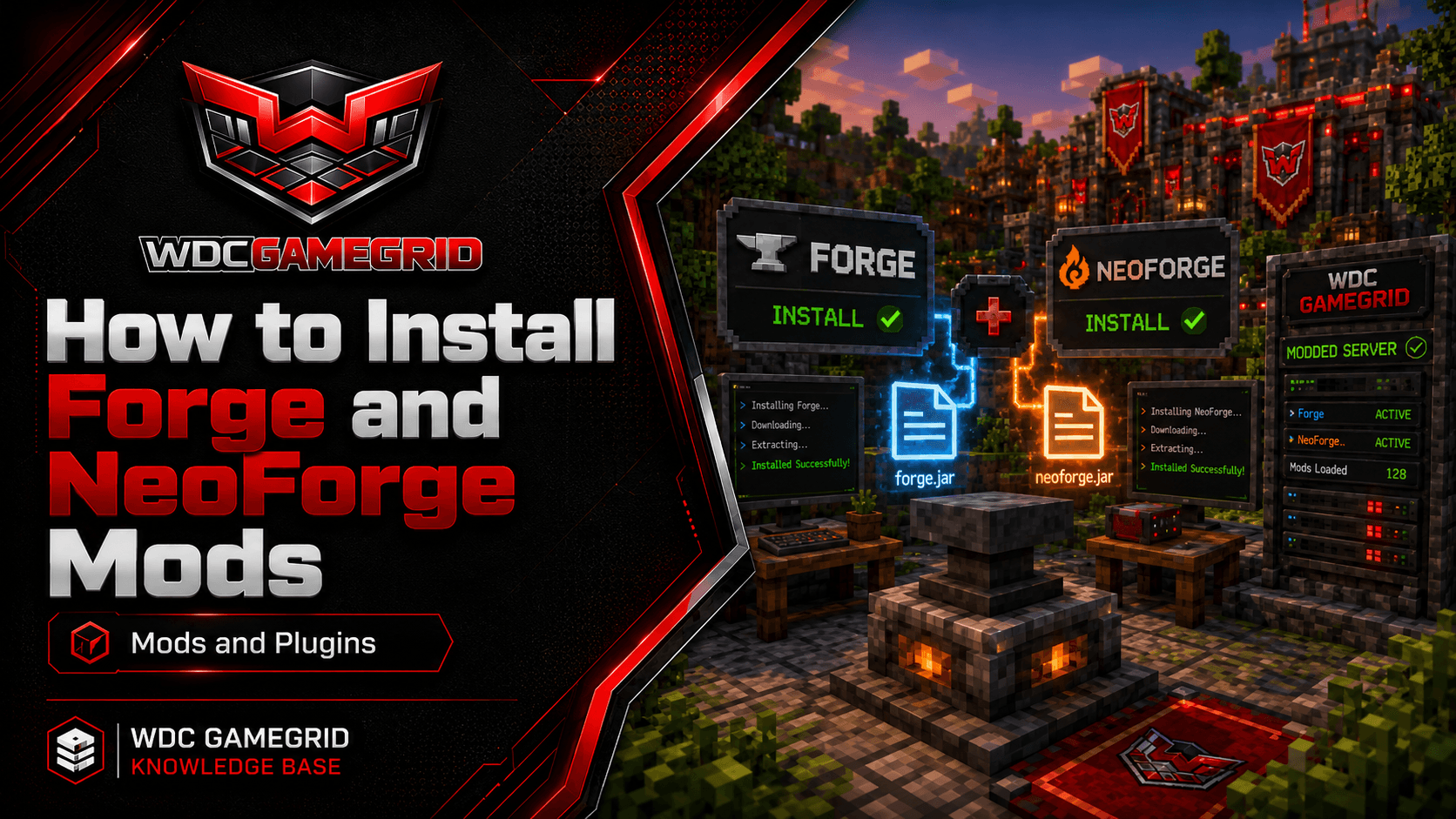
How to Install Forge and NeoForge Mods
Forge and NeoForge mod installation, dependencies, the difference between them, and why a Fabric mod will never load on either.
Forge vs NeoForge
NeoForge split from Forge in late 2023, starting with Minecraft 1.20.2, and most new mods now target NeoForge. Legacy Forge still works and is still offered here, because older modpacks target it and were never ported. Always match the loader your specific mod or modpack was built for.
If you're running a modern Minecraft version, choose NeoForge. If you're on an older pack, use Forge. The mod's page will tell you which loader it supports.
Forge and NeoForge mods are not interchangeable. A Forge mod won't load on NeoForge and vice versa.
Both loaders come with the server type - selecting Forge or NeoForge installs it for you. Java is handled by the platform as well: Minecraft 26.2 needs Java 25, and there is nothing for you to install.
Where Mods Go
Mods are .jar files and go in the mods/ folder at the root of the server, on both Forge and NeoForge. The loader reads that folder once, at startup.
Adding or removing a mod always needs a restart. Nothing in mods/ is picked up while the server is running.
Mod configs land in config/ the first time a mod loads. defaultconfigs/ holds the defaults copied into new worlds.
user_jvm_args.txt at the server root holds the JVM arguments the loader starts with.
Installing via the Mods Tab
Go to the Mods tab and click "Browse Marketplace." Search for the mod. The in-panel marketplace installs mods from CurseForge, and the search is scoped to your server's loader - a Forge server gets Forge builds, a NeoForge server gets NeoForge builds. Mods hosted only on other sites like Modrinth are not in the marketplace, but you can download them and add them with a manual upload (see below).
Click "Install" to download and place the .jar in the mods/ folder.
The "Installed" tab lists what is on the server and can remove a mod again, which deletes its files.
Restart the server.
Installing Manually
1. Stop the server.
2. Download the mod .jar from CurseForge, Modrinth, or the developer's site. Filter by your loader and your exact Minecraft version before downloading.
3. Open the Files tab, navigate to the mods/ folder, and upload the .jar. FTP works too if you are moving a whole pack.
4. Restart the server.
Many Forge/NeoForge mods require libraries (GeckoLib, Cloth Config, etc.). Install all dependencies listed in the mod's description, or the mod won't load.
The file manager does not check what loader a .jar was built for. That check is yours to make on the download page.
Why a Fabric Mod Will Not Load Here
Fabric is a different mod loader from Forge and NeoForge, not a different version of the same one. A Fabric mod cannot run on a Forge or NeoForge server, and no setting changes that.
The files give you no warning. Fabric, Forge and NeoForge mods are all .jar files that live in a folder called mods/, and the names look the same.
A Fabric mod in a Forge or NeoForge mods/ folder is either ignored or stops the server from starting - and the error rarely says "wrong loader" in plain words.
Check the loader label on the mod's page and take the build for the loader you are running. If there is no build for it, that mod does not exist for your server; find an equivalent rather than installing the wrong file.
Config Files
Forge and NeoForge mods store configs in two places: config/ for general mod configs, and per-world server configs under the world folder in world/serverconfig/.
Edit config files via the Files tab. Most config changes require a restart.
Both loaders use user_jvm_args.txt for JVM arguments, and on GameGrid it is genuinely yours: the platform passes its own heap and GC arguments before that file, and Java takes the last occurrence of a repeated option - so anything you set there, including -Xmx, wins. It is also included in your backups.
One flag to leave out: -XX:+AlwaysPreTouch. It commits the whole maximum heap at startup, which on a shared host is a problem for you and for everyone else. See Aikar's Flags.
Client-Side vs Server-Side
Same rules as Fabric: client-side mods (shaders, minimaps) go on the player's client, not the server. Server-side mods (performance, admin) go on the server only. Both-sides mods (new content) must be installed on both.
Check the mod's page for which side it's needed on. If it says "client-side only," don't put it on the server.
The Server Won't Start After Adding Mods
Start from the mod you added last - it is the culprit far more often than not.
1. Open the Console tab and read from the top of the startup output. The first error is the cause; later ones are consequences of it.
2. Note the mod named in the error. "Missing dependency", "Incompatible mod set" and MixinTransformerError all carry a mod id.
3. Stop the server, remove that mod from mods/ via the Files tab, and start again.
4. If it still fails, move every mod out of mods/ into a folder like mods-disabled/ and start with an empty mods/ to confirm the server itself is fine.
5. Add mods back a few at a time, restarting between batches, until the failure returns.
Full output is in logs/latest.log and crash-reports/, both downloadable from the Files tab.
Common Issues
Version mismatch: The mod must match the exact Minecraft version and Forge/NeoForge version. Check the mod's supported versions.
Missing dependencies: Check the Console tab for "Missing dependency" errors. Install the required library mods.
Mixin conflicts: Two mods modifying the same code can crash. Look for "MixinTransformerError" in the crash report. Remove mods one by one to find the conflict.
NeoForge vs Forge: Make sure you're using the right loader. A Forge mod on a NeoForge server won't load.
Fabric mod on a Forge or NeoForge server: same class of problem, and just as common. Re-download the correct build.